Play My Miss: Inside the Riskiest Decision in Rocket League

Caroline Phoenix Henry · Wed Nov 04 2026
A dive into aerial plays in Rocket League along with insights from the Keiser University team and their coach, Corrupt, Wichita State's captain, Aqua, and one of Winthrop's players, Phantom.
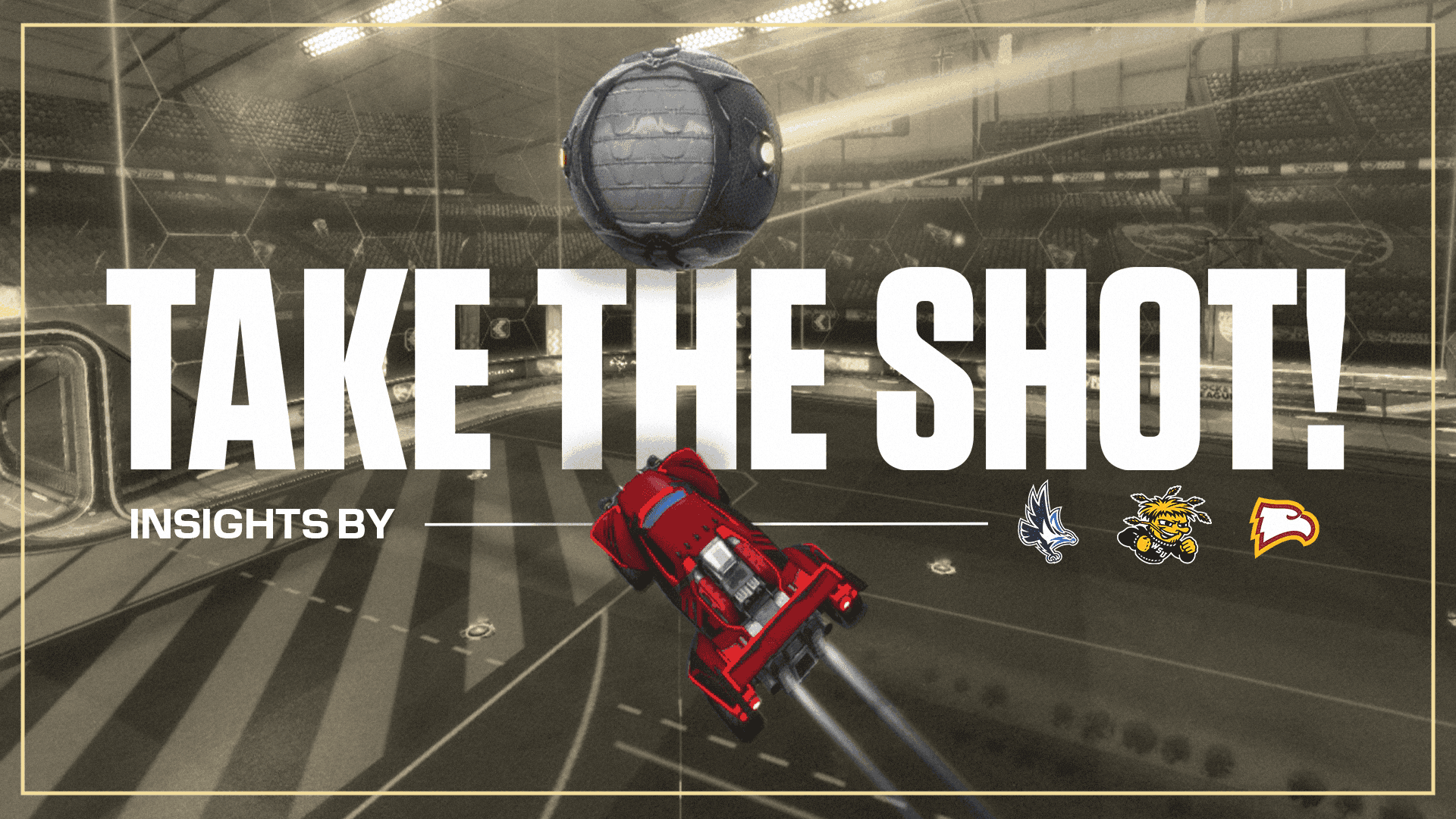
When a player leaves the ground in Rocket League, the rest of the team is essentially a man down until the result of that play. Being in the air, which players do by boosting themselves vertically with their car, aka flying, doesn’t allow much maneuverability or changing of direction. This is what makes aerial plays so risky. Rocket League is new to DivisionONE this season along with this aerial playstyle. We interviewed DivisionONE Rocket League competitors, the Keiser University team, “Kfrost”, “Denzy”, “Trbo”, and their coach, “Corrupt”, Wichita State’s captain, “Aqua”, and Winthrop’s player, “Phantom,” to discuss the riskiest decision in competitive Rocket League.
Risk & Reward
Why do players commit to aerial plays in Rocket League if they are so risky? Aerial plays provide a vertical advantage in games due to the height of the goal and map compared to the small cars. Players can score a goal over others’ heads or juggle the ball across the field if they can master their control while flying. It’s uncommon in lower ranks, but collegiate and pro players use flying a lot in their gameplay. It’s a matter of maximizing reward over risk.
When asked about those times when the risk isn’t worth it and they pass on an aerial opportunity, players and coaches agree that it’s situational based on the play and opponent’s car language (communication that’s predicted by another car's movement, acceleration, positioning, etc).
Kfrost (Keiser): There’s a lot of times like when you’re entering a first-man play, the first one to challenge the ball, and I feel like awareness is the biggest factor in that. You have to gauge what you see on the field--that you know where your opponents are, where your teammates are, and you have to make the best decision off of that. If someone may pre-jump you (anticipate your jump and jump first for the advantage), obviously, you don’t wanna go for the aerial. It’s really risky. So, you either hit it around them or you keep it grounded for a 50-50 (players hitting the ball at the same time). A lot of times, it’s just using your eyes and understanding the best play to do.
Denzy (Keiser): It’s situational based on what’s going on in the field like KFrost said. It depends on what the defense is covering. Another big thing is situational awareness—where your teammates are, is there an opponent on the backboard (the wall directly above each goal)? Obviously, you don’t wanna go in the air if that’s happening. Also, do you have boost? If you don’t have boost, you can’t really do anything up there.
Coach Corrupt (Keiser): The only thing that they're missing is that it’s really about depth. If someone’s gonna beat you to that ball, you don’t wanna waste your boost like Denzy said. If you don’t have the boost, you can’t go for these types of plays. It’s more understanding that, if they can win, we don’t wanna commit in case it becomes a 3vs2. We keep the pressure with 3vs3, so it’s really about that depth perception of understanding what you could win and what you're weak to.
If the ground is less risky, it would be reasonable to assume that it provides a better position. Its increased maneuverability alone is tempting. It’s a toss-up whether there’s a state of the map where aerials are something that shouldn’t be done ever, with most interviewees saying that it depends on whether the opponent is countering them by being intensely aerial or shutting down their aerial attempts.
Kfrost (Keiser): This actually happened in our Maryville series in DivisionONE. Higher level players really understand the car’s movements. [Maryville has] experienced and veteran players when it comes to understanding the direction of your car and where you’re gonna go. When we started making really high value/high risk aerial plays, they immediately caught onto that and started pre-jumping us. They knew we were gonna go for a dribble off the back wall or something and they’d already have a guy pre-jumping us. It was every single match that we encountered those scenarios. Sometimes we’re better at adjusting mid-game, or we’ll have the confidence to keep going for it and break down our opponents. But, Phantom has a different view on stopping aerial plays and staying on the ground:
Phantom (Winthrop): I think aerials are always going to be a part of a match. Lower ranks, yes, because a lot of people can’t aerial in lower ranks. In high-rank lobbies, especially at the top of collegiate, you’re never gonna see people on the ground 24/7. Almost every ball is an aerial more than it is a ground play. You could take a 50-50 on the ground and then that will end up leading to an aerial play no matter what, almost 90% of the time. I don’t think aerials ever get left behind.
Even though there are times where players don’t go for aerial plays, there’s much more times in professional play, especially in high levels, where it seems like teams spend more time in the air than on the ground. Missing the ball while in the air is a very dangerous risk that disrupts the team. How long players are out of action depends on how severe the miss is.
Captain Aqua (Wichita State): When a player whiffs a ball in the air, that definitely halts the flow of rotation that’s happening. When that flow of rotation gets disrupted, it could have an impact for 30 seconds or even longer sometimes. Usually, to break out of that, the following players need to execute mechanically to make up for that mechanical mistake. Let’s say, something that we do is make sure we’re communicating on that, and, as the person supporting the person that whiffed, we don’t always wanna play for the most optimal thing ever. You shouldn’t be too surprised, especially if it’s a difficult touch to get, but there is a level of trust. It can throw us off sometimes. It probably shouldn’t, but we’re at a skill level where you should be able to make up for it. It shouldn’t be a total loss, but it definitely does put you in the negative.
Practice
Interviewees seem to agree that the way to comfortability with aerial plays is practice. All of these DivisionONE players are full-time students and balance esports practice on- and off-campus to perform well in these Rocket League competitions.
Learning the art of flying in Rocket League separates low-ranked from high-ranked gameplay. It’s something that you have to go out of your way to learn and it takes continuous practice. Aerial plays aren’t necessary for normal play, but are crucial in competitive play. A lot of players in DivisionONE use training packs or community-made workshop maps that are targeted at developing different types of aerial techniques or utilize the freedom of free play.
Denzy (Keiser): A lot of it is training. I know a lot of pros that stay in training. They only do training sessions for like eight hours a day. For me, I would say it’s definitely a combination of playing a [regular] game and playing in free play when I started. I did a lot of training packs on PlayStation and Xbox, both ranked and casual games. It’ll make you better, because there’s actual pressure on the field. I would call it exposure therapy. With my new keybinds, I started playing a lot and got better quicker. There’s levels to that concentration and training. It depends on how much effort and thought you should put into it.
Captain Aqua (Wichita State): You have individual training of training packs, workshop maps, all of that stuff, free play, and then you have actually applying that practice. Scrims are our good practice for everything. For specifically practicing aerial plays, you could definitely do it in free play. It’s more so trying to visualize what you’re going to do and then trying to imitate what you visualized. That’s what I have my players practice doing.
There are also drills that you can do. For example, in Rocket League, you have air roll (tilts the car in the air on one or two of its axes), you have free air roll (holding the air roll button and manually moving the direction) , and then you have directional air roll (press the air roll button and the car rolls in the direction it faces). What I have my players do [as a coach for WSU's lower-tiered teams] is try to fly in the air in a [horizontal] circle with no air roll. That is because most players, when they’re in the air, they always use air roll, but, if you’re able to control your car with the same level of precision without air roll, you get a lot more understanding of your car. On the ground, it’s a 2-D space. You can go left, right, forward, backwards. But in the air, you can also go up and down, which adds a whole other level of complexity. That is why it’s much harder to be consistent at it. It’s understanding how your car moves essentially and getting a feel for it. Practice how your car moves and then training packs help when you actually do stuff with the ball.
Phantom (Winthrop): I’m not a big fan of training packs. There’s only one training pack I used to ever do, and it was just to get warmed up. I rarely ever do them anymore. I think the best way to get better at aerials is to sit in free play and try to control your car in the air. [For example,] focus on getting somewhere in the air and go there in as many attempts as it takes. Keep doing it over and over. Repetition is how you get better at the game, and that’s all it ever will be.
Trbo (Keiser): When I first started the game, it was one of those things that--it didn’t come naturally--but, it’s when you go on YouTube to look up freestyle plays. That was the first thing that really caught my attention, so I put tons of hours into wanting to be like those players. Over time with practice, it kind of went well for me.
The work that players do in practice things like aerial plays contribute to their own skill now, but they still train as a whole team with scrims, practice matches usually against other universities or club teams. These two things split up their time. How much time is allocated to each is something that isn’t agreed on even between teammates and coaches.
Kfrost (Keiser): I’d say 30% is individual, then 70% is team.
Denzy (Keiser): I’d say about a 30/70 split like what Kfrost said. We all play outside of Keiser. We all play 2vs2 by ourselves, 3vs3 by ourselves outside practice. You get what you put into it. I practice aerials a lot outside of our practice time, not just aerials but everything. Most training packs are shooting, aerials, dodge control, or hard reads (predicting where the ball or player is going to go to counter effectively) off the wall. Pretty much, everything is aerial.
Trbo (Keiser): I completely disagree. I think, if I’m listening correctly, it’s 95% individual when it comes to getting good at aerial mechanics. Five percent of the time with the team, if you’re just starting out, you never really make an aerial play for your team. A lot of the time, there’s gonna be a ground score. Once you get higher up, I’d say it’s a little bit more team-based. With our CRL (Collegiate Rocket League) team, I’d say 5% is team and the rest of it is 50% in individual free play and the other 45% in ranked or whatever game mode that you play by yourself.
Coach Corrupt (Keiser): I’m more inclined to say 50/50, because I agree with Trbo and what he brought and then also with KFrost and Denzy, where, as a team, you have to learn how to play off of each other and learn each other’s tendencies in the air. That helps you understand what they’re actually capable of, and it’s easier to understand what happened from the play. I also agree with Trbo saying that the likelihood of us playing two people on an aerial play is super low. There are a lot of teams out there that love to pre-jump and pinch (a play where the ball gets squeezed in between a car and another surface like another car, the wall, etc. then gets shot out at a high rate) things or pre-jump and throw a pass. We’re definitely not one of them. I think it’s more 50/50 practicing in free play and mixing it up by playing ranked and pushing yourself aerial-wise.
Captain Aqua (Wichita State): There’s only so far you can go with team chemistry and team skill. At some point, you need to have your individual consistency in order to improve as a team, because, although as a team you might be really, really good, it’s gonna be harder to break into the next tiers of skill in Rocket League. That’s where the individual side comes in. If I had to do a percentage split, it’s probably like 70% individual and 30% team based. Maybe a little bit closer. I would say it’s more individual simply because, as a team, you’re still practicing the stuff you would practice with your team. You’re just doing it while focusing on yourself. There are individual things that you can make sure to practice that make it easier for the team like getting good 50-50s or rotating with the flow of the game. It’s about a 70/30 split I would say.
Air time consistency, however, isn’t something that coaches or players really track. The stat is at the mercy of what’s going on per game, per opponent’s gameplay, and whether aerials are appropriate or not at any given moment. How much or how long you're in the air is irrelevant unless it’s something you want or need to work on.
Kfrost (Keiser): I’ve never looked at the stat [consistently]. I go on BallChasing, a replay-group website where I can see all the stats and breakdowns of a match, and sometimes I see what percentage I am in the air versus the ground. I’m more inclined to stay on the ground, because I don’t have the greatest aerial mechanics compared to my teammates or opponents. Something I’ve been trying to do in the past two weeks is push myself in the air more than usual and, basically, train more in the air. I know the number is pretty low; I think it’s around 30% in the air then the rest is on the ground. I’m trying to get a little bit better or find more value in the air.
Teamwork
A big risk with flying and aerial plays is that this is a team game. Players must coordinate with their teammates, so that not everyone is in the air at once. If everyone is in the air, it leaves the ground, which is much easier to maneuver on, free for the opponents to claim. High-level players, like the ones in DivisionONE, balance flying and aerial plays between them in order to get the most reward out of it. Though, risk will always be a factor, even with the most skilled players.
Communication, or comms, is a staple in team gameplay to compete effectively without problems. Every competitive game, including Rocket League, has different ways of doing this with articulation and in-game terms.
Captain Aqua (Wichita State): That is a very good question, because it varies a lot from player to player. You have a couple of levels of communication in that type of situation. You have the surface-level communication of saying “I got it,” but that doesn’t really give your teammates anything about what you’re doing. The second level would be to show your intention, not by just your car language, but also by saying you’re going to hit the ball in a spot where your aiming or, if you’re trying to go for a mechanic or a 50-50, trying to verbally say that, because that allows your teammates to act on what you’re doing quicker.
It’s not only communicating what you’re going to do individually. Teams must plan for who has the green light for an aerial play to minimize open goals and lack of grounded backup in case of problems. That person changes constantly during gameplay with players that are in better positions, have boost, or are more aggressive taking the risk.
Phantom (Winthrop): Especially with our team, I think everybody gets the greenlight to go for aerials. Obviously, Percy and Tcorrell (his teammates), they’re 10 times better than me, but I still have confidence that I can make aerial plays. When you’re playing at such a high level, everybody should be able to have a green light to go for an aerial play, because everybody should be able to support it no matter what happens in the scenario. It depends on who’s in the better position to go for the aerial, but everybody can have the green light to go for it. In high ranks, you should be able to aerial and, whether or not you have the mechanics to follow up and score off it, doesn’t really matter as long as you make contact with the ball and do what you’re trying to do with the aerial.
But, even great comms can be offset by a bad play, and aerial plays frequently have consequences even in the higher tiers. Sometimes it’s something you can see during the play and be able to tell your team about.
Coach Corrupt (Keiser): It’s not really this roster as much as our other ones, but, in certain situations where you’ll be trying to force somebody off the ball and there’s a very high chance of them being able to beat you, you could just say “play my miss,” so that the guys behind you understand that, yes, there’s a chance of you hitting the ball, but there’s a stronger chance that you’re just gonna get beat (the opponent gets control of the ball first). It’s a simple comm. We love to joke around a little bit even in serious matches. It keeps it light, keeps the boys moving forward, and keeps our head in the right direction.
That rise in emotion that can come from a miss is something that players must have a way of not letting it affect their performance.
Trbo (Keiser): Honestly, there isn’t a set thing that we all do. Sometimes we’ll just laugh it off, sometimes we’ll be like “all good, all good, all good.” Most of the time, it’s trying to keep us all level. Whiffs are gonna happen. They happen at the highest level, so making sure that we’re good for the next goal is the main goal.
Phantom (Winthrop): I can take this into my own perspective. Literally last series, I played terribly [against] Maryville. I was even missing aerials. It happens; everybody has those days. When you’re at such a high level, everybody’s expecting you to hit the ball on a basic aerial, especially if it’s coming [straight] at you. Nobody is going to expect you to miss. The whole conversation after it misses is that you can’t let it get to your head. I'm really bad at that. If I make one bad play, it's instantly in my head. It’s keeping the mental ability to know that shouldn’t have happened. You’re better than that. Nine times out of ten, you’re hitting [the ball]. All that really matters is being able to keep your headspace right to make that play next time.
Aerial plays have a high risk to them, but it is something that is important to competitive Rocket League. The situation in the game changes whether they’re worth it or not. Hearing opinions from Keiser University’s team, Kfrost, Denzy, Trbo, and their coach, Corrupt, Wichita State’s coach, Aqua, and Winthrop’s player, Phantom, helped shed light on how six people who do this at a high level don't agree on when to go up, how much to practice it alone, or whether it's a stat worth tracking. What they do agree on is that the decision happens faster than it can be explained.

Articles by Caroline


DivisionONE's First Pro Class: Six Signings and a Shot at the LCS
By Caroline Henry · Wed Sep 23 2026
A recap of all of the players in DivisionONE's first year that have gone pro and where they currently are now, and a brief look at Maryville's recent League of Legends Promotional Tournament qualification.

Articles like this
DivisionONE's First Pro Class: Six Signings and a Shot at the LCS
By Caroline Henry · Wed Sep 23 2026
A recap of all of the players in DivisionONE's first year that have gone pro and where they currently are now, and a brief look at Maryville's recent League of Legends Promotional Tournament qualification.