5 minute read
Contextualizing Performance With Data Visualization

Sean Seven Bevensee · Mon Mar 30 2026
A personal exploration into the decision making and aspirations with the release of our latest data visualization widgets. How we plan to simplify performance into a digestible format for both new and seasoned fans alike.
Among the ideals that D1CE was founded on, a digestible website has always been the most difficult to implement. A hub of information is simple enough, but to meet the high expectations we set for ourselves, that information needed to be both intricate and shaped in an approachable way. The goal was to answer simple questions like "Who is the best player?" or "Is Team A better than Team B?" using easily understood statistics. That functionality has been sorely lacking in the collegiate esports space and we knew it was a mark that we could not miss if we wanted to create an impactful conference. And, while I'm proud of our work so far, I always felt like that was an area we could significantly improve on.
I do still have faith in our existing statistics table, but if you aren't familiar with VALORANT the barrage of acronyms might as well be hieroglyphics. Honestly, that fact goes for regular players too—I went years not knowing what KAST stood for despite playing on a varisty roster. We needed something more visual, more intuitive. Something that an esports layman could use and have no trouble distinguishing a "good" record from a "bad" one.
That objective is what led us to create the new comparison widget.
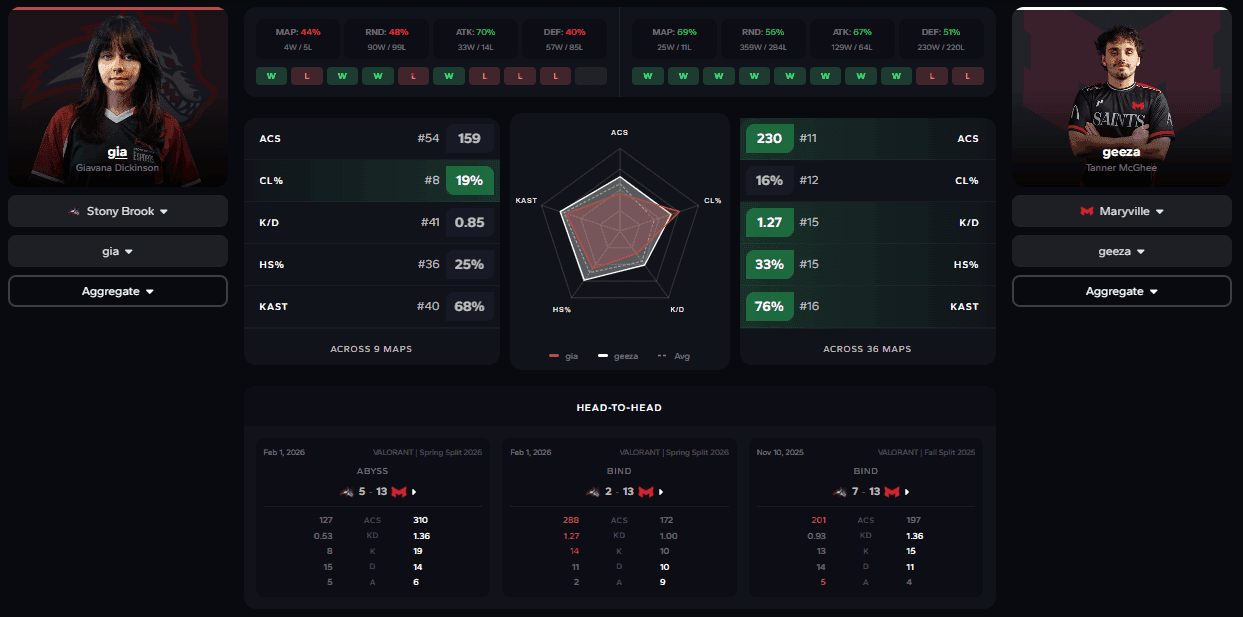 example of a player comparison between stony brook's gia and maryville's geeza
The comparison widget does exactly what it sounds like and enables the user to directly compare two entities. At the time of writing, the platform supports both player and team objects. Meaning the performance of any two players or any two teams can be directly compared.
The relevant data is arranged such that important data is displayed first, with the radar chart in the center serving as a visual summary of overall performance across key metrics, allowing users to quickly identify strengths, weaknesses, and differences between the chosen entities. That tertiary intersection contextualizes the data enough to sufficiently prove superiority of one entity over another while still respecting nuance. For example, one team might have better stats across the board, but the inferior team might still hold the edge in specific cases:
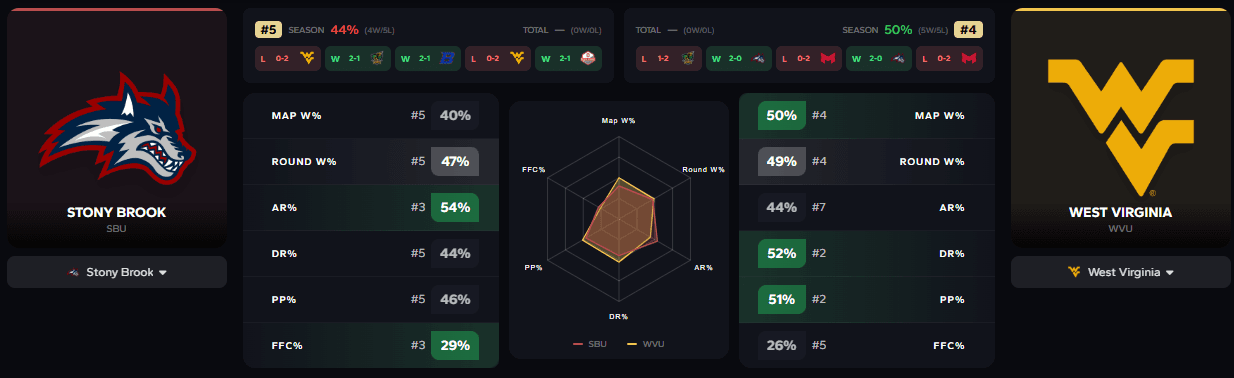 team comparison between stony brook and west virginia in which wvu has the better aggregate but sbu's superior attacking round win percentage is noticable
While radar charts are notoriously criticized for their use in data visualization, we feel the desired effect is achieved: within seconds of opening the page, the user gets an understanding of skill between two players. Both scale and nuance are preserved.
Beyond the radar chart, the comparison tool can also be used to source other relevant statistics. The farther down the page the user goes, the more detailed the data becomes. As I was building this tool, I found myself captivated by the information I was missing out on even after watching a majority of our games.
My personal hope is that the fanbase will allow this information to influence their opinions. I want people to use this feature to size up two teams before they play a match or see which roster's ace has a higher chance of leading their team to victory. I touched on this briefly before, but statistical representation in collegiate esports is highly fragmented, inconsistent, and often incomplete across titles and conferences. That fact has contributed to one of the industry’s core problems: a lack of culture. No one (that I have personally met) has a favorite player, or roster, or even team. Exceptional performances get swept under the rug all the time and the fanbase loses another thing to celebrate.
If we did our job right, the next contender for collegiate esports' goat status should be discussed when our next season of Division ONE rolls around. Anything less is a failure in my eyes and I am fated to take to the drawing board again.

Articles like this


The Importance of Coaching in Collegiate Esports
By Alexavier Alvarez · Sun May 10 2026
An inside look at the role coaching plays within Division ONE esports, from strategy and VOD review to player management and team culture. Featuring perspectives from coaches across VALORANT and League of Legends, this article explores the challenges of building competitive collegiate programs and the work that happens behind the scenes long before match day begins.

The Division ONE Awards
By Alexavier Alvarez · Wed May 06 2026
A full year of Division ONE competition came down to this. From undefeated championship runs to breakout performances and dramatic turnarounds, these awards recognize the teams and players that defined the 2025–2026 collegiate esports season across VALORANT and League of Legends